Debt and Food Costs Put Pressure on Cambodia’s Farmers and Working-Class Families
📅 August 26, 2026
Smallholder farmers and food producers face rising debt as high production costs and low market prices leave them with limited control over seeds, farming decisions and market access, while debt bondage remains a troubling issue for urban working-class communities
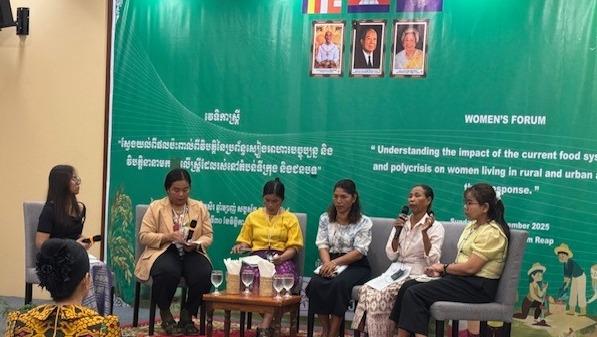
Household debt is putting pressure on both rural farmers and urban working-class communities, raising concerns about their livelihoods and access to affordable, nutritious food, according to discussions at a public forum in Phnom Penh.
The August 21 forum was held under the theme “Understanding Current Food System Crises, Their Implications for Local Food Systems, and the Responses of Local Communities and Peasant Movements’.
Organised by Social Action for Community and Development, Focus on the Global South, United Sisterhood Alliance and GRAIN, the event brought together farmers, food producers, workers, community representatives and participants from across Asian nations to discuss challenges facing local food systems and possible community-led responses.
For smallholder farmers, the pressure begins with the rising cost of agricultural production. Farmers often depend on external inputs, including seeds and other agricultural products, while the prices they receive for their harvests may not keep pace with investment and production costs.
As a result, some farmers are forced to turn to loans to continue farming or repay existing debts, creating a difficult cycle when crop prices fall after harvest.
"Farming leads to falling into debt mainly because many companies are pushing us to use their products, with both the government and local authorities encouraging farmers to use company inputs like fertilizers and pesticides,” said Om Samol, a representative of the land- related impact in Pai Lin.
“We cannot save our own seeds, and the people lack knowledge. Their education level is still limited, so they just follow others. This results in falling into debt because agricultural inputs are expensive, but when we sell our farm produce, the prices are low, causing us to end up in debt,"
The forum highlighted concerns that smallholder farmers have limited control over important parts of the agricultural system, including the choice of seeds, production decisions and access to markets. According to event organisers, farmers also face difficulties retaining or choosing seeds for future planting when production is shaped by market requirements and commercial agricultural systems.
For farmers already struggling with debt, the choices can become increasingly difficult. Continuing agricultural production may require taking on additional loans, while stopping farming could mean losing an important source of income or livelihood.
Smallhold farmer Hy Sochan, who is also Secretariat of Anchanch Roung Samaythemy women's agriculture cooperatives, said some farmers are discouraged and are losing hope because they depend entirely on agriculture. She said changing weather patterns cause severe hardship, to the point where they fear losing the ability to support their families. Sochan attributed the problem to climate change, particularly deforestation caused by certain powerful individuals.
“Modern agriculture is also a major challenge because it differs greatly from small-scale and local farming. Modern agriculture uses large machinery, whereas smallholder farmers rely on manual labour, creating an unfair gap and causing small farmers to suffer immensely. These issues are caused by large corporations or public entities with financial power asserting influence over smallholder farmers,” she said.
The forum therefore sought to provide a space for farmers, food producers, workers and other affected communities to share their experiences and raise concerns about ownership and control of local food systems.
Sochan stated that there are numerous issues surrounding current farming methods and agricultural systems related to the heavy capital required to purchase supplies. Promoting modern agriculture has also negatively impacted local farming.
When asked how farmers or solution-seekers can ensure they have ownership over their own agricultural systems, Sochan said the loss of ownership over farming systems has driven many farmers into debt. Large companies control agricultural inputs, while farmers have little control over the system.
“No farmers are making a profit or improving their livelihoods through agriculture; instead, the majority fall into debt because of those inputs. To reclaim ownership, farmers need to save their own seeds, use local resources, and reduce their dependence on external inputs,” said Sochan.
“We are building community-led farming systems by saving our own seeds, producing our own fertilisers and remedies, and establishing savings groups to support family farming. Every year, we organise a ‘Seed Festival’ to exchange and preserve local seed varieties.”
The food system challenges discussed at the forum extend beyond the rural communities as urban working-class people, including workers in the garment, footwear and travel-goods sectors, also face pressure from everyday living costs. Workers' incomes can be stretched by expenses such as housing, food, utilities, transportation, children's education and family responsibilities.
Sreymom Loem, of the Worker’s Information Centre , cited examples of workers trying to keep their daily food spending as low as 5,000 riel ($1.25), purchasing small portions of rice and cooked food, sometimes accompanied by an energy drink. Such meals may include fish, pickled vegetables, salted eggs or dried fish.
“Workers earn a base salary of $200 a month while working long shifts under strict production quotas. There are many struggles inside the factories that workers often do not speak about or share with their families,” Sreymom said.
“Today, workers are expected to operate two or three different machines, moving from one task to another with little time to rest. They are also competing with automated machines that can operate around the clock, and workers who cannot meet production targets risk losing their jobs.”
Participants and guest speakers from Cambodia and other Asian countries also discussed possible alternatives to the challenges facing local food systems, with a focus on responses developed from local perspectives.
Nim Chheang, a smallhold farmer, agroecology practitioner and the representative of the Rangpen Bei Tor fishery community, shared a practice and alternative from family experience.
“Over the past 30 years, the use of external agricultural inputs, including commercial seeds, chemical fertilisers and synthetic pesticides, has continued to increase. This has depleted natural resources and contributed to health concerns, while heavy debts have also forced some families to migrate for work,” Chheang said.
“I started farming through a flooded forest conservation programme, but when conservation efforts weakened and crop yields declined, I reconsidered my approach with my children. Together, we established a three-hectare farm focused on biodiversity, traditional farming practices and sustainable agriculture.”
Link: Sayya Phin/ KIRI POST
← Back to News